
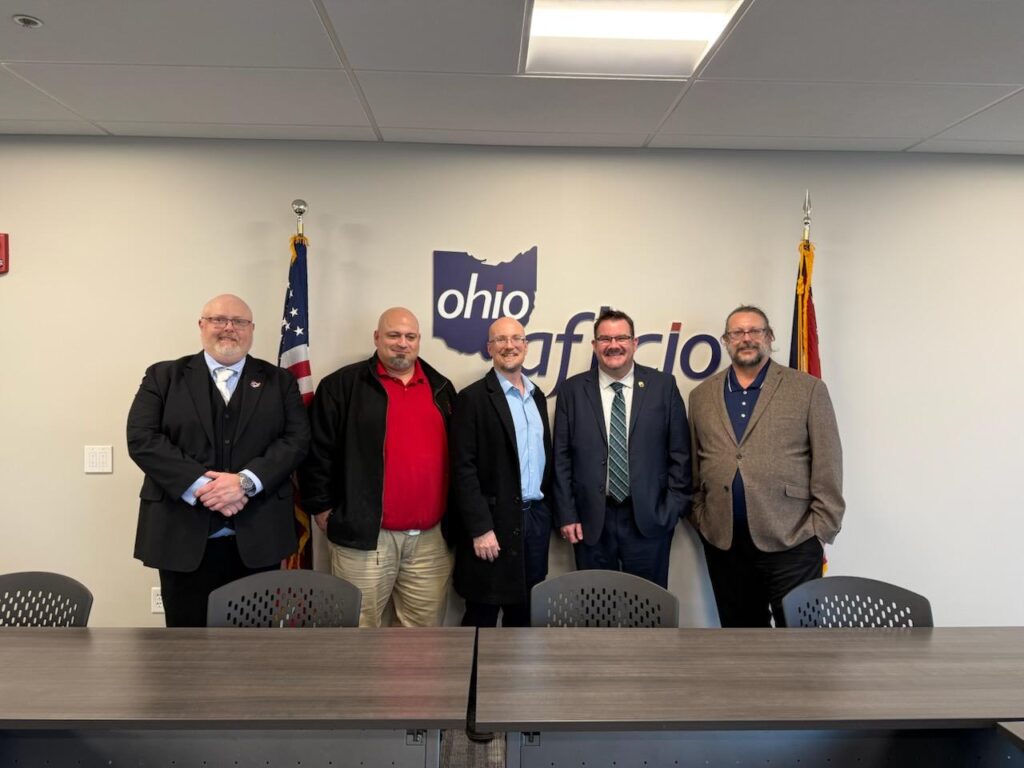
Attendees in the photo (left to right): Clyde Whitaker SMART-TD, James Ramey BRC, Jason Cox National Rep. BRC, John Easterly BLET, and Jason Harkleroad BRS.
Jan. 24, 2026 – This week, representatives of TCU’s Brotherhood of Railway Carmen (BRC) Division met with Senate offices in Ohio and Indiana to discuss ongoing safety issues in the Class I freight rail industry, as part of a broader rail labor effort to advocate for passage of the bipartisan Railway Safety Act.
BRC National Representative Jason Cox and BRC Local Lodge 6760 Chairman James Ramey met with staff from the offices of U.S. Senators Jon Husted and Bernie Moreno in Columbus, Ohio. They were joined by representatives from SMART-TD, BLET, and BRS.
“I’m proud of our union for standing up for what’s right,” said National Representative Jason Cox. “Safety shouldn’t be optional in the railroad industry. Our members are highly skilled mechanics who spend hundreds of hours training to recognize and remediate safety defects on railcars. Safety means empowering the right people to do the jobs they were trained to do—not harassing them to inspect faster or relying on unqualified personnel.”
Additionally, Local Lodge 6738 Chairman Ramon Del Rio met with Senator Todd Young’s Office in Indiana. “As a constituent of Senator Young and as a Local Chairman representing Hoosiers across the state, I am very appreciative of Senator Young’s office for hearing our concerns on rail safety,” said Local Chairman Del Rio. “I’m looking forward to continuing to work with Senator Young and his office to improving rail safety across Indiana.”
These meetings come as TCU, BRC, and the rest of rail labor continue to urge Congress to pass the Railway Safety Act ahead of the three-year anniversary of the tragedy in East Palestine, Ohio.
The bipartisan bill—endorsed by both former President Biden and current President Trump, as well as by both the former and current U.S. Secretaries of Transportation—was introduced with bipartisan support in the House of Representatives.
The legislation would improve rail safety in communities through a variety of measures, including prohibiting railroads from imposing time restrictions on railcar safety inspections and requiring expanded use of Qualified Mechanical Inspectors (QMIs) when inspecting railcars and locomotives.
In addition to inspection-related provisions, the bill would:
- Enhance safety procedures for trains carrying hazardous materials
- Reduce the risk of wheel bearing failures
- Increase rail carrier accountability for safety violations
- Provide additional support for communities impacted by rail disasters
- Invest in the development of technology to further improve rail safety
“Rail workers know firsthand that safety corners cannot be cut without consequences,” said BRC Division General President Don Grissom. “As the anniversary of the East Palestine derailment approaches, rail labor is urging lawmakers to act before another preventable tragedy occurs.“
Passing the Railway Safety Act would be a critical step toward protecting workers, communities, and the nation’s rail network by ensuring inspections are thorough, professional, and driven by safety—not speed or profit. Congress must move this bipartisan legislation forward and hold rail carriers accountable for putting safety first.